
Reviewing my three public accounts — my first review
Three accounts, all in the red. What I got wrong, what I got right, and what I do next.
When I worked at a venture capital fund, we reviewed every investment after it played out — what we got right, what we got wrong, what to change next time. It's one of the most useful habits I picked up there, and I never dropped it.
I've run three public portfolios for a while now and never once reviewed them out loud. So this is the first review. An honest one, with the goal of fixing the mistakes I can actually fix.
All three are down right now:
Table 1
| Portfolio | What's in it | Where it is |
|---|---|---|
| BTC | Bitcoin only | −23% |
| Portfolio 1 | Main altcoins (ETH, SOL) | −31% |
| Portfolio 2 | AI + RWA coins | −23% |
I'm not going to hide that. A public track record only means something if I show it on the bad months too.
What I got wrong
I kept no cash on the side. I put almost everything in and held no stablecoins. That's the real mistake.
Here's why it matters. When the market falls, the smart move is to buy more at the lower price. But I can't — there's no cash in the account to do it with. And I can't just add money now, because these are public portfolios. Putting money in while prices are low would look like I'm dressing up the results. So the cash needed to be sitting in the account from the start. It wasn't.
Bitcoin is the clearest example. I bought at $77,000, which felt cheap to me. It's near $61,000 now — exactly the kind of dip I'd want to buy — and that account has nothing left to buy it with.
I think I know where this habit comes from. At the VC fund, the pattern was simple: put the money in, then wait — sometimes for years — for the company to exit. That's the right instinct in venture. It's the wrong one in crypto, where the same price comes back to you a month later and rewards you for having cash ready. I brought a venture habit into a liquid market.
I also had no plan to take profit. When a coin climbs above what I paid, I should sell a little and move it to cash, ready for the next drop. Crypto always drops again. But you can only use those drops if you're holding cash when they come.
One rule fixes both: keep some cash in every account, and trim a little when a coin runs above my cost.
What I got right
I don't regret the coins. The one-year picture is why.
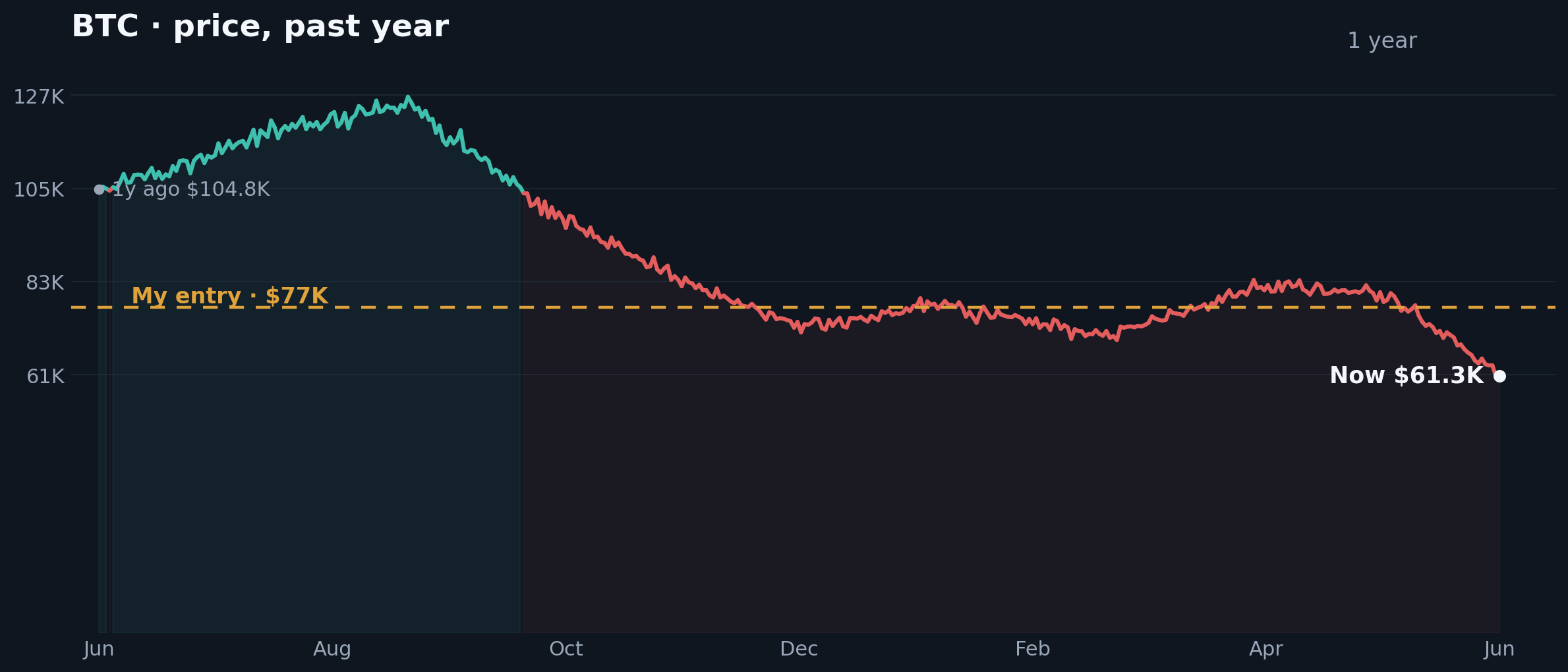
A year ago, Bitcoin was about $105,000. I paid $77,000 — and a year ago wasn't even the peak. BTC was above $120,000 in 2025. So I didn't buy the top. I bought well below where it had already traded.
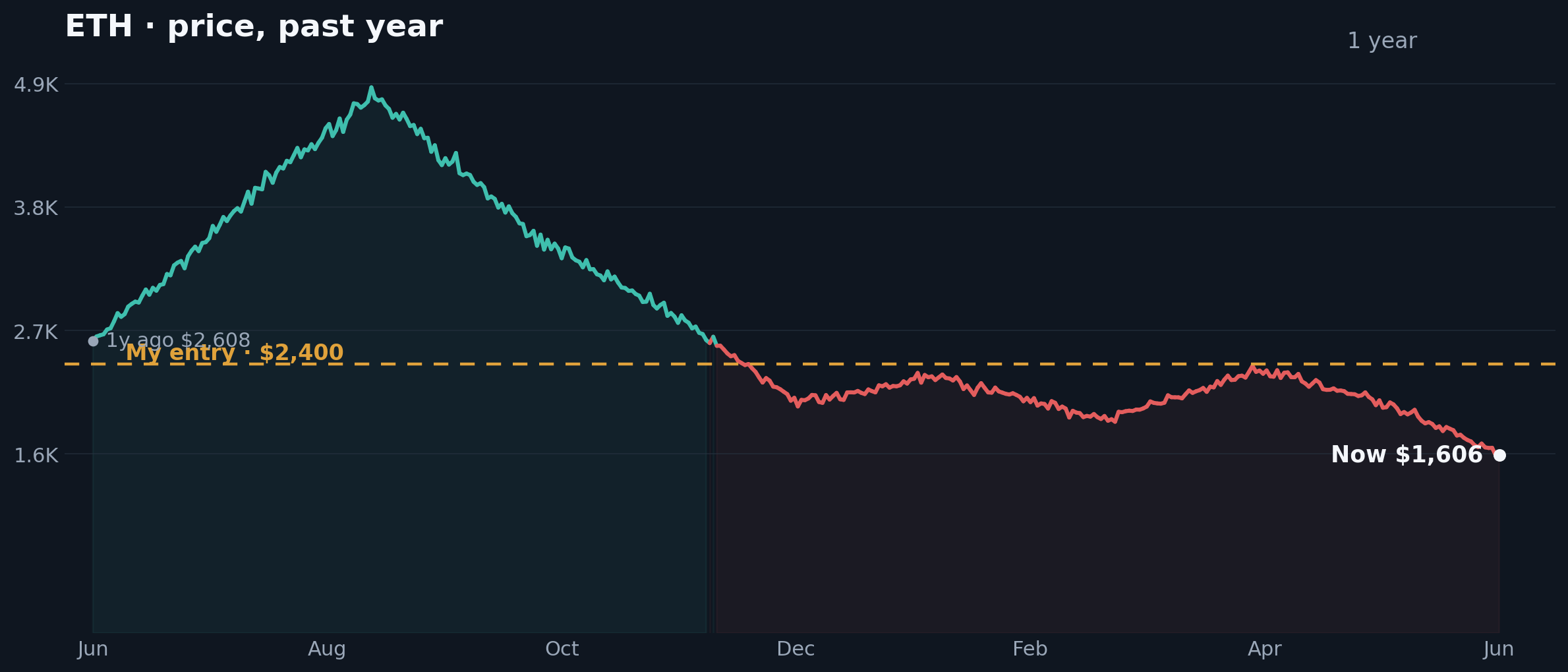
Same with Ethereum: about $2,600 a year ago, near $4,700 at its 2025 high, and I paid around $2,400.
Table 2
| Coin | I paid | Now (approx) |
|---|---|---|
| BTC | $77,000 | ~$61,000 |
| ETH | $2,400 | ~$1,600 |
| SOL | $100 | ~$65 |
| NEAR | $2.90 | ~$1.90 |
Even my worst pick fits this. I bought NEAR near $2.90 and it's about $1.90 now — down roughly 40% in days. It looks bad, but $2.90 was a recent high, not the high (NEAR was near $3 back in late 2025). I bought it because I believe AI coins benefit from where this is heading. I still do.
My view hasn't changed: Bitcoin, Ethereum, and the major coins recover and go higher, and AI and RWA are where the next wave lands.
Why I'm not selling
Eight years in crypto. I've sat through worse than this. It's uncomfortable — a paper loss never feels good — but it isn't dangerous.
Every coin in these accounts was researched before I bought it. Most have long histories. BNB burns supply every quarter. Solana already survived the FTX collapse in 2022. I don't think any of this dies here, so I'm not selling into the drop.
What I do next
- BTC and Portfolio 1: wait. There's no cash to deploy, so patience is the only honest move.
- Portfolio 2: this one still holds some stablecoins and BTC. That's the cash I'll use to buy the AI and RWA coins lower.
- From now on: keep cash in every account, and trim a little into cash whenever a coin is about 10% above my cost — even when I think it goes higher.
Bottom line
The coins were fine. The setup wasn't. I'd buy these again — I just won't go all-in again and leave myself no room to act. That's the lesson from the first review, and it's the one I'm taking into the next one.
Read next
 MrNasDog Pressure FrameworkWhy $100 in Hyperliquid became $354 while Worldcoin fell to $27, and the three checks we use before we buy.
 Why Did WLD Crash?Millions of people use World, yet WLD is down about 95%. Nobody needs to buy the coin, and new WLD arrives every day.
 Why I Sold Half My LINKA big LINK release is due in October. Last year the same release came right before a big fall. Why I sold half for Bitcoin.
 Your New Member HomeMembers can ask any investment question and book a one-to-one call with MrNasDog, every month.
My own opinion. I can promise I am authentic — no one can promise to be correct in markets. Not financial advice. Do your own research.
Was this page useful?