Our investment system
MrNasdog Pressure Framework
Why one coin turned $100 into $354 while another left $27, and the three checks we use to spot the difference before we buy.
This audio is generated by an AI tool.
(This is our own framework, not financial advice. We could be wrong.)
Imagine you put $100 into two famous coins on New Year's Day 2025. One was Hyperliquid. The other was Worldcoin. Both had big names behind them and plenty of people talking about them. Today, the Hyperliquid money is worth about $354. The Worldcoin money is worth about $27.
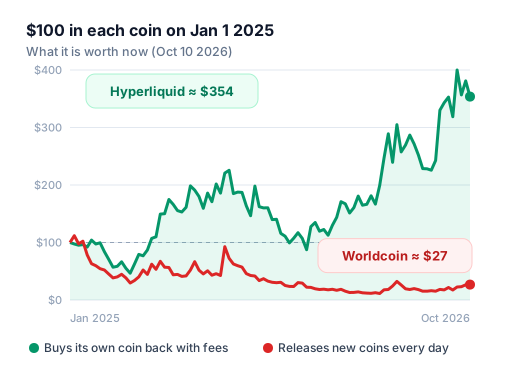
So what made the difference? It wasn't luck, and it wasn't the chart. Look at what happened to the number of coins. Since the start of 2025, the number of Worldcoin on the market has grown to about four and a half times what it was. Hyperliquid's hasn't grown at all. Instead, Hyperliquid kept using its trading fees to buy its own coin back, about 47 million HYPE so far.
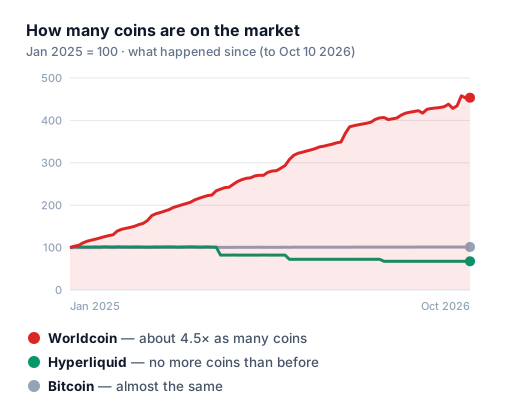
That's the whole story. One coin kept flooding the market with new coins. The other kept taking coins off it. Spotting that difference before we buy is exactly what our framework is for.
We started out as venture capital investors, and we've lived off crypto since 2018. Over those years, one question never went away: which coin should we buy, and when? The MrNasdog Pressure Framework is our answer. It comes down to three simple checks, and we run them on every coin we follow.
1How many new coins are coming?
Start with Worldcoin. Its team, its early investors and its foundation kept unlocking their coins, month after month. That's how its supply grew to four and a half times in less than two years.
In crypto, people call this token inflation, or token emission. Put simply, it's printing new tokens. Every new token is one more coin that somebody can sell. And if the number of buyers doesn't grow just as fast, the price slowly gets pushed down. Worldcoin holders lived through exactly that.
Bitcoin is the opposite. Only miners get new Bitcoin, and over the same stretch its supply grew by about 1%. Almost nothing. So our first check is simple: how many new coins arrived over the last 90 days, and how many are scheduled for the next 90 — every unlock, every reward, minus anything burned or bought back.
2Is somebody buying?
New coins are only half the story. The other half is who wants them. We look at two kinds of buyers.
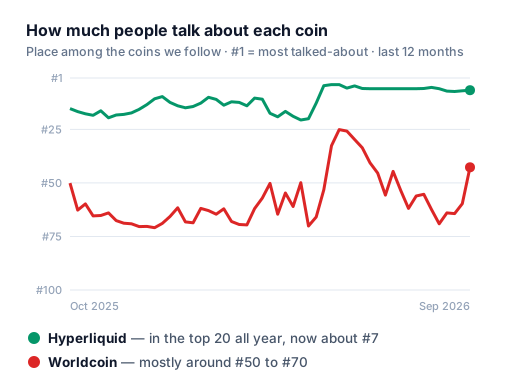
The first kind is people. How much is a coin talked about on X, Reddit, YouTube and TikTok? How often do people search for it? Is the buzz growing or fading? Over the past year, Hyperliquid stayed among the 20 most talked-about coins we follow, and today it sits around number seven. Worldcoin spent most of the year down around number 50 to 70.
The second kind is the strongest buyer of all: the project itself. Hyperliquid runs a busy trading platform, and traders pay fees on every trade. Hyperliquid takes that income and uses it to buy HYPE back from the market. The more people trade, the more HYPE it buys. That's where those 47 million coins went.
To find coins like this, we compare a coin's price with the fees it earns. We call it P/F, price to fees. When a project earns a lot for its size and spends that money buying back its own coin, we know there's a real buyer coming over the next three months. For coins that don't earn fees, we look at what venture capital firms and research teams expect for them instead.
3Who else can move the price?
Some coins have giants standing behind them that no simple check would catch. We call these price drivers, and Bitcoin is the best example.
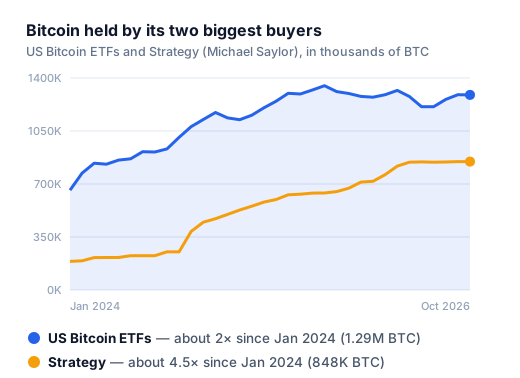
Look at its two biggest buyers. In January 2024, the US Bitcoin ETFs held about 660,000 Bitcoin. Today they hold about 1.29 million, roughly double. Strategy, Michael Saylor's company, went from about 190,000 Bitcoin to about 848,000, around four and a half times as much.
Then there's the famous four-year cycle, the rhythm around each halving that has shaped every Bitcoin boom and crash so far. We can't predict what Michael Saylor will do tomorrow. Nobody can. But we can watch him every day. So for every coin, we find its two or three biggest drivers and mark each one as pointing up or pointing down for the price.
4What the checks say today
That's the past. Here's how the same two coins look right now, on our three checks.
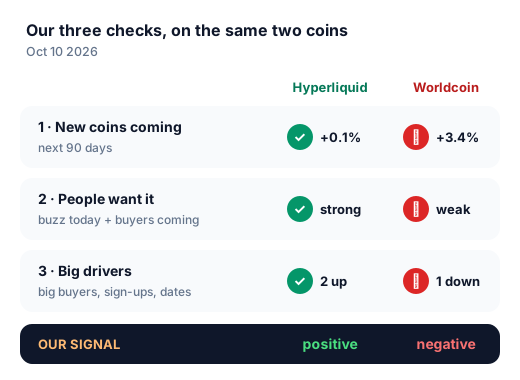
Today, Hyperliquid still passes all three: almost no new coins in the next 90 days, strong demand, and its drivers pointing up. Worldcoin still fails all three: about 3% more coins coming in the next 90 days, weak demand, and its biggest driver, new people signing up, has nearly stopped.
It's the oldest rule in any market: more buyers and fewer sellers usually means a higher price. When a coin lines up like Hyperliquid, the odds of its price going up are much, much better than average. When it looks like Worldcoin, the odds point the other way. That's why every coin page on our site ends with one simple signal: positive, mixed or negative. Under it, we answer the questions people really ask, like "should I buy now?" or "should I sell or hold?"
Overall
So that's the MrNasdog Pressure Framework. It's about one thing: making money in crypto by buying the right coin at the right time. We're trying to predict when to buy, by watching how many new coins are coming over the next 90 days, how many buyers are coming, and what the big price drivers are doing. Pick any coin we cover, like Bitcoin, Ethereum or Solana, and you'll see all three checks side by side.
 Hyperliquid (HYPE)All three checks, live→
 Worldcoin (WLD)All three checks, live→
 Bitcoin (BTC)All three checks, plus its big buyers→
(This is our own framework, not financial advice. We could be wrong.)
Questions people ask
What is the MrNasdog Pressure Framework? It's our way of picking which crypto to buy, and when. On every coin we check three things: how many new coins are coming, whether buyers are growing, and what the big price drivers are doing. When all three line up, the odds of a rising price are much better.
How do you know which crypto to buy? We look for coins with few new tokens coming, growing demand and big drivers pointing up. When all three line up, the odds of a rising price are much better.
What is token inflation? Token inflation is how fast a coin's supply grows when new tokens are printed or unlocked. More tokens with the same buyers usually means a lower price.
What is token emission? Token emission is the schedule a project uses to release new tokens, for example as rewards to miners or stakers.
Do token unlocks push the price down? Often, yes. Unlocked coins can be sold, so big unlocks add supply that buyers have to absorb.
What is a crypto buyback? A buyback is when a project uses its income to buy its own coin from the market, like Hyperliquid does with its trading fees.
What does P/F mean in crypto? P/F compares a coin's price with the fees it earns in a year. A low P/F means the project earns a lot for its size.
Why did Worldcoin's price fall? Since January 2025, the number of Worldcoin on the market grew to about four and a half times, while interest stayed weak. More coins with few new buyers pushed the price down.
When is the best time to buy crypto? When few new coins are coming, buyers are growing and the coin's big drivers point up, ideally before the crowd notices.
How do you make money investing in crypto? By buying coins where buyers are likely to outgrow sellers, and holding while that plays out.
Was this page useful?