Will Bitcoin Reach $1 Million?
This audio is generated by an AI tool.
There are only two questions.
- Will the world have more money?
- If yes, will some of that money buy Bitcoin?
If both answers are yes, the price goes up. If either one is no, it does not.
That is the whole thing. Here is what I found.
Question 1: Will the world have more money?
First, look at what already happened
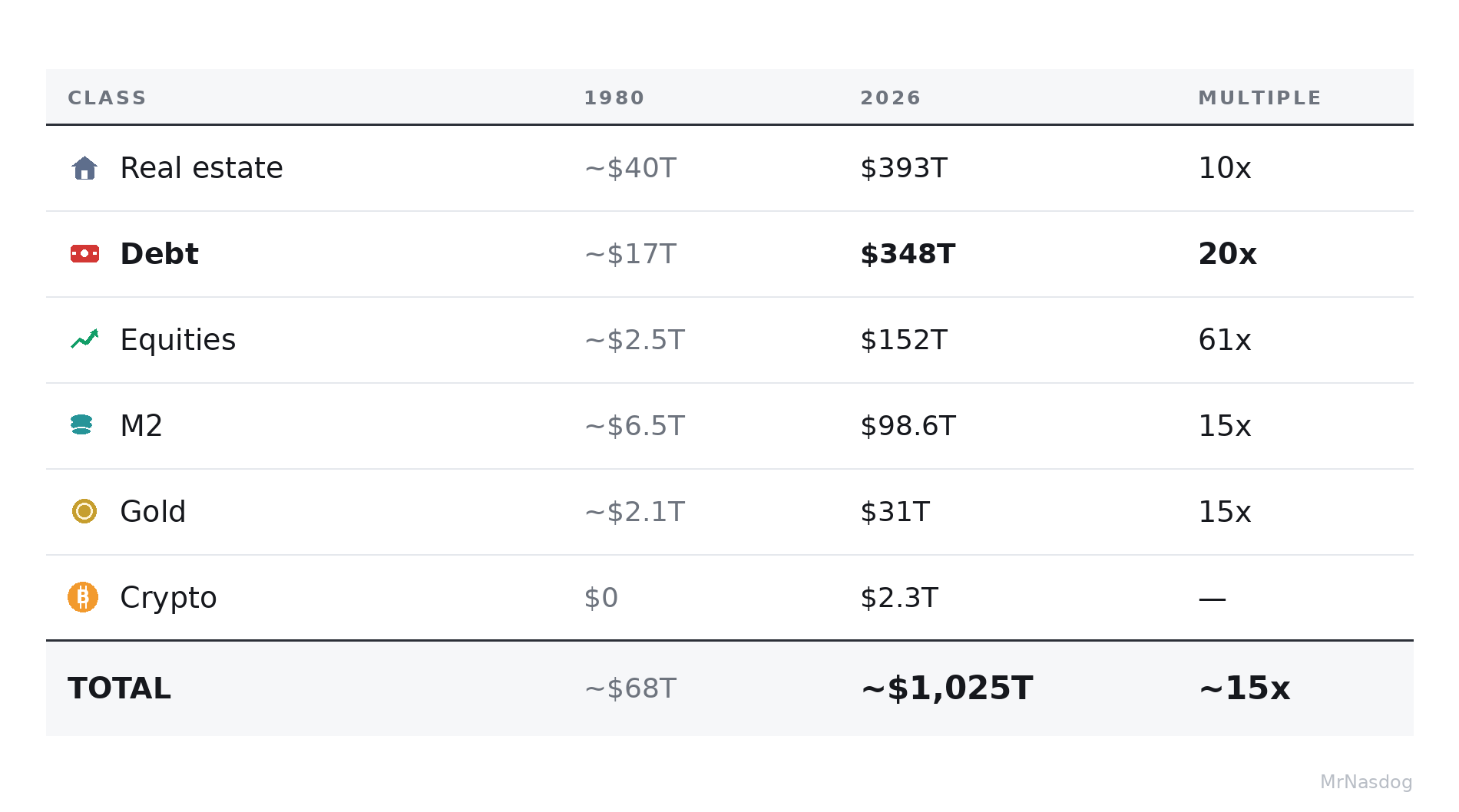
In 1980, everything in the world was worth about $68 trillion.
Today it is worth about $1,025 trillion.
That is 15 times more, in 46 years.
Two rows matter most:
- Debt grew 20 times. From $17 trillion to $348 trillion.
- M2 grew 15 times. M2 means broad money — cash plus bank deposits.
Debt and M2 tell you how much money exists. Both went up more than ten times.
This is not a guess. It already happened.
But will they keep doing it?
This is a fair question. The past does not decide the future.
And right now, something new is happening. Governments are writing rules for digital money:
- Russia signed a digital currency law
- The US passed the GENIUS Act
- China and Europe are building their own digital money
Maybe this is the moment they finally stop printing.
So I read the laws.
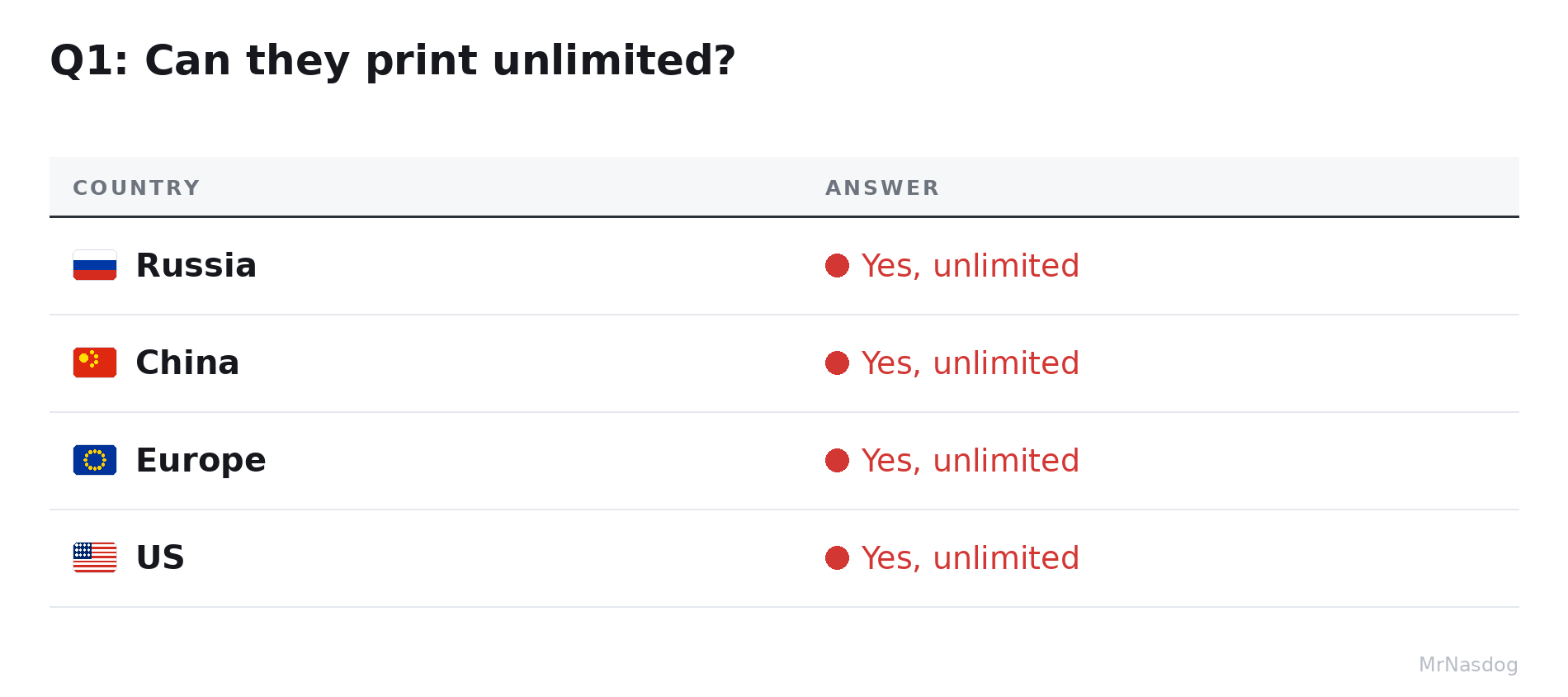
None of them stop a central bank from making money.
They control exchanges. They control stablecoins. They control who can sell what.
But not one of them puts a limit on the bank that makes the money.
Think about that. These are the biggest money laws in fifty years. And they leave the tap open.
And governments want more, not less
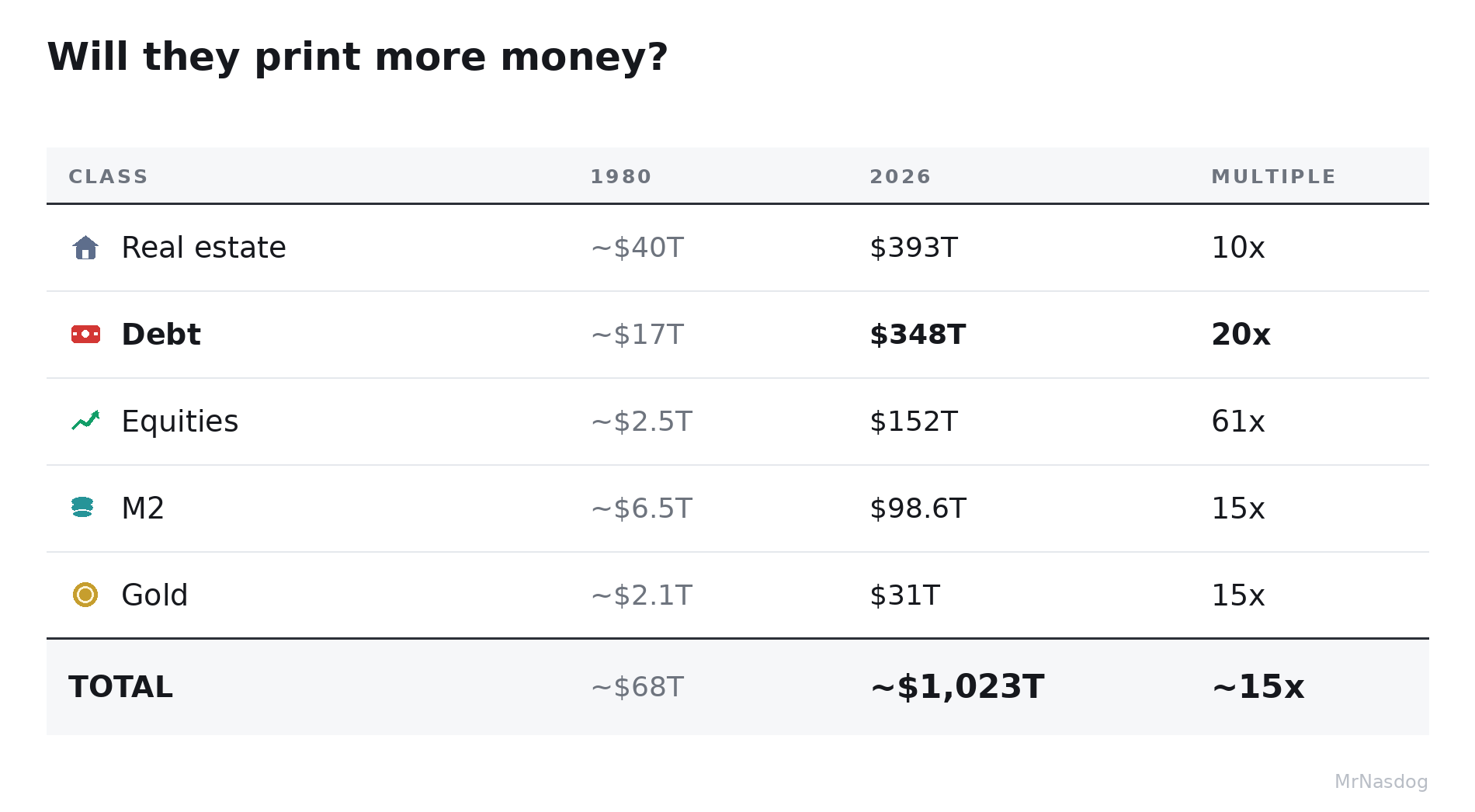
Governments almost never ask for less money.
When the economy slows down, they ask for lower rates. They ask for more spending. Every country with big debt wants the same thing.
So the pressure only goes one way.
How much money by 2056?
Assets grew 15 times in 46 years. That is 6.1% per year.
BCG, a big consulting firm, thinks it will be 7% per year from here.
I will use the smaller number — 6.1%. I would rather be too careful than too excited.
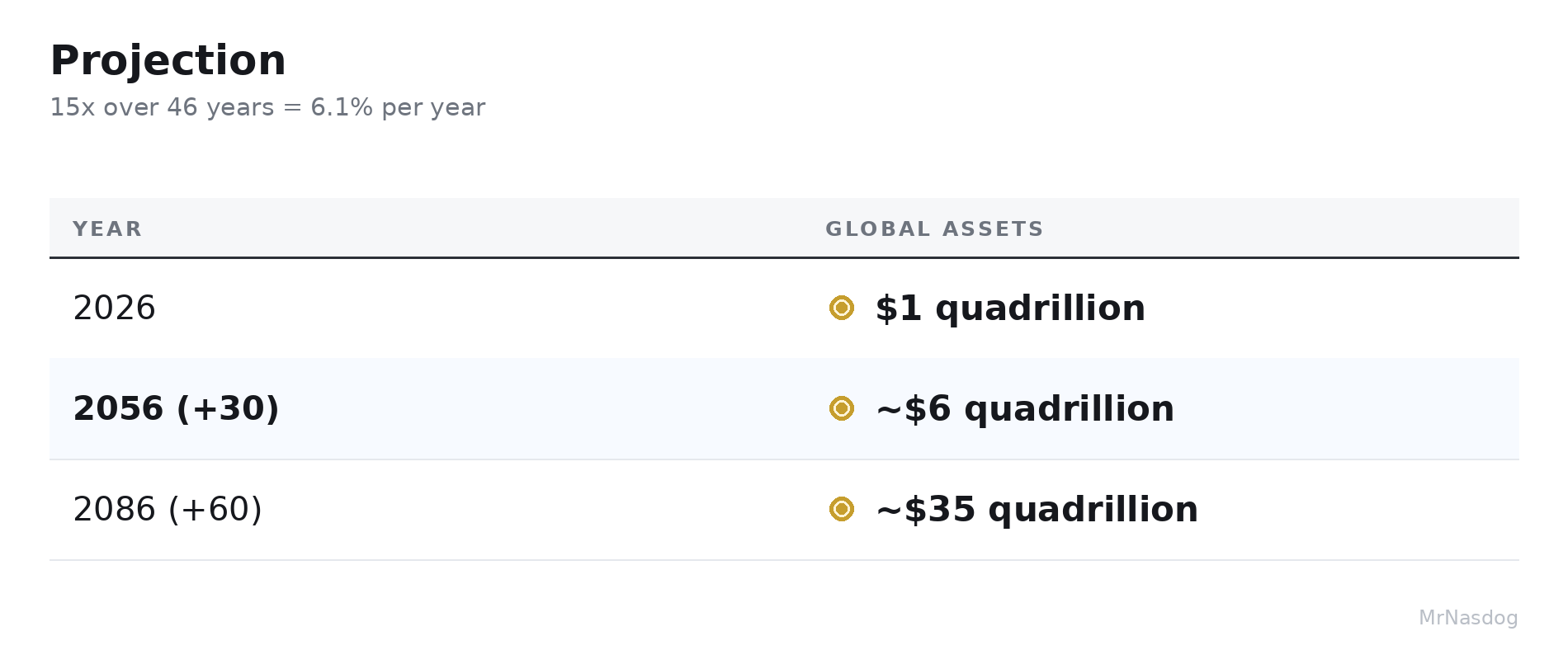
Answer to Question 1: yes. More money is coming.
Question 2: Will that money buy Bitcoin?
More money in the world does not mean Bitcoin gets any of it.
To answer this, we need to talk about something else first: can your money be watched?
Money has been getting easier to watch for 2,000 years
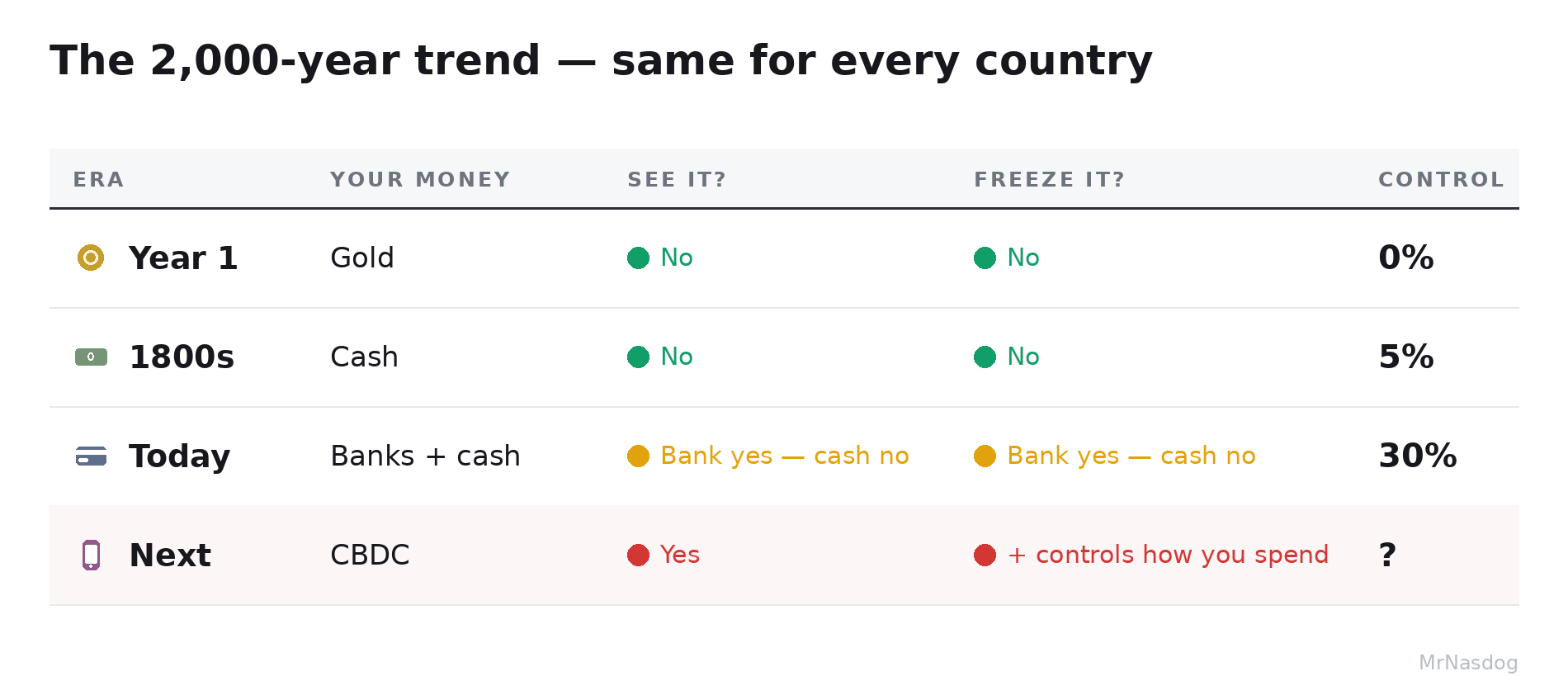
- Year 100: almost 0%. Money was gold. Nobody could see it.
- Year 1800: about 5%. Governments were stronger, but money was still physical.
- Today: about 30%. We use banks and cards, and those leave records. But cash still exists, and no one sees everything.
Every step, control went up. It never went down.
What CBDC really changes
CBDC means digital money made by a central bank.
People think it is just a faster bank transfer. It is not.
Today, your bank holds your records. If a government wants them, it has to ask the bank.
With CBDC, the central bank makes the money and holds the records itself. There is nobody to ask.
Russia is the clearest example. Its central bank issues a digital ruble. People are supposed to use it instead of cash.
Cash was the last part of money that nobody could see. Take away cash, and there is nothing left that is private.
This does not mean anyone will freeze your money. It means they now can, easily and quietly.
So which money would you choose?
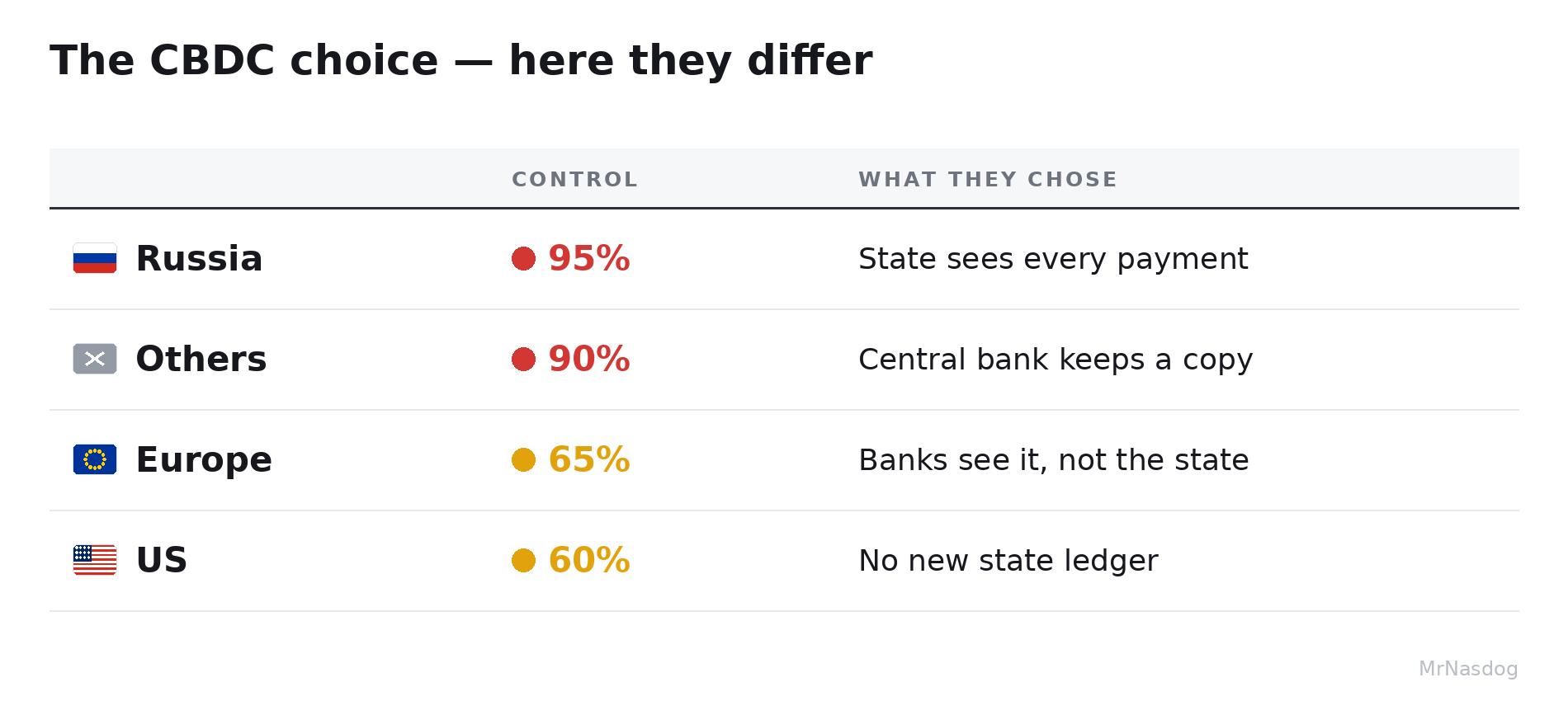
If you had to pick one, most people pick the US dollar. Not because they love America. Because it has less control than the others.
And people already do this with real money:
- People in Argentina hold about $255 billion outside their banks
- About 75% of bank deposits in Lebanon are US dollars
- About 80% of payments in Cambodia are US dollars
- More than half of all US cash is held outside the US
So people already move their money to escape control. They just never had a fifth choice.
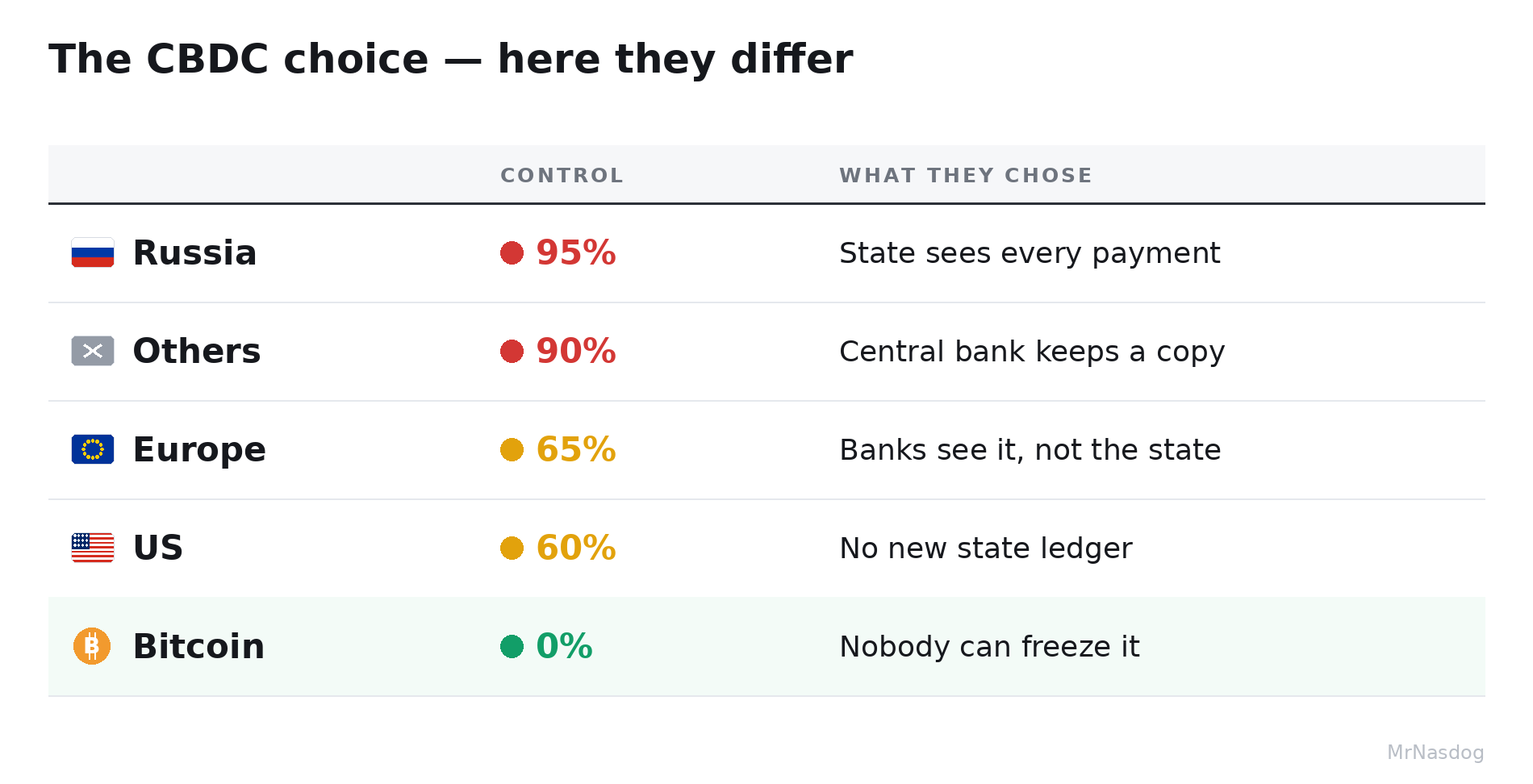
Bitcoin is the only one where nobody can see your balance, freeze your account, or prove the coins are yours.
“I follow the law. Why do I need this?”
Maybe you don't. That is a fair answer.
But the price does not need you to buy. It only needs someone to buy.
And some people are not choosing. They are being pushed.
Here is a real example. This November, California votes on the 2026 Billionaire Tax Act (Initiative No. 25-0024).
It is a one-time 5% tax on everything you own — if you own more than $1 billion.
Not 5% of what you earn. 5% of everything you own.
It should raise about $100 billion from about 200 people.
Those 200 people did nothing wrong. Their only problem is that they are rich, and everyone can see it.
Now imagine the same tax in a world where the government sees every account in real time. Where do you go? You cannot run. They can see where the money went.
Now add everyone else who needs privacy: sanctioned countries, politicians, and families in countries that block money from leaving.
All of these people have one thing in common. They are very rich.
The part most people get wrong
Bitcoin's price does not depend on how many people buy it. It depends on how much money buys it.
One million people buying $10 each = $10 million.
One hundred people buying $10 million each = $1 billion.
A hundred times more money. From a group ten thousand times smaller.
Almost every group above is small in number and very large in money.
Answer to Question 2: yes. Money has a reason to come here.
The supply side
This is the part most people skip. It is also the most important.
Look at the table again. Every asset grew. But growing does not mean the price goes up.
Houses. Real estate grew 10 times. Your house did not grow 10 times. Why? Because they built more houses.
Cash. M2 grew 15 times. But a $100 bill is still $100. It did not change at all. They just printed more bills.
In both cases, the new money went into more things, not higher prices.
That is the escape door. Almost every asset has one.
Bitcoin does not.
- Maximum supply: 21 million
- Already made: about 20 million
Nobody can make more. There is no board that can vote for it. There is no emergency button.
So when new money arrives, it has nowhere else to go except the price.
If the Bitcoin market grows 10 times, the price of one Bitcoin grows close to 10 times too.
Every other asset can make more of itself. Bitcoin cannot.
Putting it together
Price is decided by two things: demand and supply.
- Demand: more money is coming, and some of it needs an asset nobody controls.
- Supply: fixed at 21 million, forever.
High demand. Fixed supply. You already know what that does to a price.
But I do not know the number, and I do not know the timing.
So I will ask you instead. What price do you think Bitcoin reaches by 2030? And by 2056?
One more thing
There may also be a buyer who spends $5 trillion, or even $10 trillion, on Bitcoin.
For comparison: US GDP is about $32 trillion. Global GDP is about $126 trillion.
Who is this buyer? I will show you in the next article.
I will also answer the biggest technical worry about Bitcoin: quantum computers.
Where I could be wrong
I would rather write this myself than read it in the comments.
- Governments could limit central banks. I see no sign of it. But no sign is not the same as impossible.
- 6.1% may not repeat. The last 46 years were unusual. The next 46 may be slower.
- Privacy money could go somewhere else. Gold. Art. Or something that does not exist yet.
- Fixed supply is not the same as fixed available supply. Lost coins and big holders change how much can actually be bought.
- Quantum computers. The most serious technical risk. It needs its own article.
Read next
 Don’t Buy Coins at the Wrong TimeAfter a sharp rally, a little patience may give us a cheaper entry. Real price charts and 547 qualifying rallies across our website’s first 20 coins.
 A Leverage That Can Never Be LiquidatedWith 3x leverage, one drop below the line and the money is gone. Strategy (MSTR) behaves like 3x Bitcoin — and a stock has no liquidation line at all. With the video.
 Lab · Our first AI videoThe market is quiet, so we tried something new — a video made with AI, about a janitor who left behind $8 million.
 Lab · AI image generation — test #1I tested AI image generation with Claude Code + ChatGPT. The exact prompts, and what came out.
This is research, not financial advice. My analysis may be wrong. Nobody can be 100% correct. Please do your own research.